Content Tips for People Who Don't Like Making Content
I've posted 30-plus pieces of content in just over a month — and I'm not an oversharer. Here are four things that actually helped me post more often.
I've posted 30-plus pieces of content to my feed in just over a month. And I'm not an oversharer. I don't feel anxious pressure to post constantly — that's never been me. But I do love to teach. I do love helping other people. And I want my business to grow, which means helping more people.
So I put all the resistance behind me and jumped in. Here are some of the things that have helped me post more often — not as theory, but from watching my wife Julia do this at an elite level for fifteen years, and from doing it myself every day for the past month. One of these tips — the last one — might be the most important thing I've ever shared about creating content. I hear the same version of it from almost everyone I talk to.
If you're taking part in the Press Publish Challenge this week, these tips should make the whole thing feel a lot less painful.
You don't have an ideas problem. You have a chunk-size problem.
When I started posting daily, I thought I'd run out of ideas in a week. The opposite happened. The more I created, the more ideas I had.
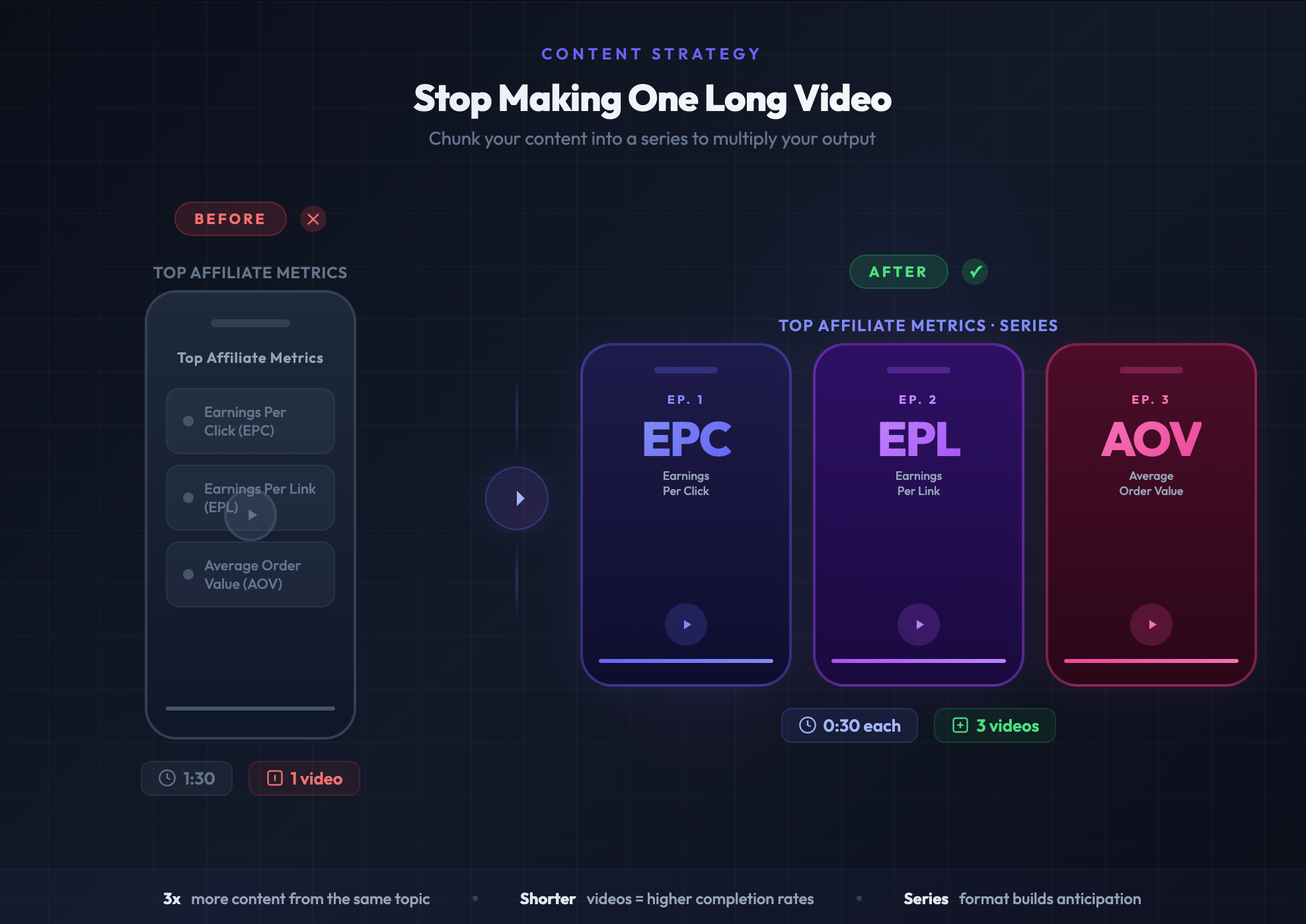
The shift came from learning to think smaller. I naturally want to go big — cover everything in one post. But when you break one idea into smaller pieces, that single topic becomes three, four, five posts. You're not running low on ideas. You're trying to say too much at once.
Bonus tip: we all hear about how important hooks are. I've been working so hard on the hooks in my content that my content ideas now come to me loosely formed as hooks. If I can't frame something as a strong hook, it's probably not a standalone post — it's a supporting detail inside another one. That shift alone gave me a clearer filter for what to post and what to save.
Stop writing. Start talking.
I used to sit down and try to write, and it felt like fighting. I'd struggle over every single word. I would go back and forth trying to get things right. It wasn't that I didn't enjoy writing — I did. But I kept asking myself, "Why am I putting myself through all this pain?"
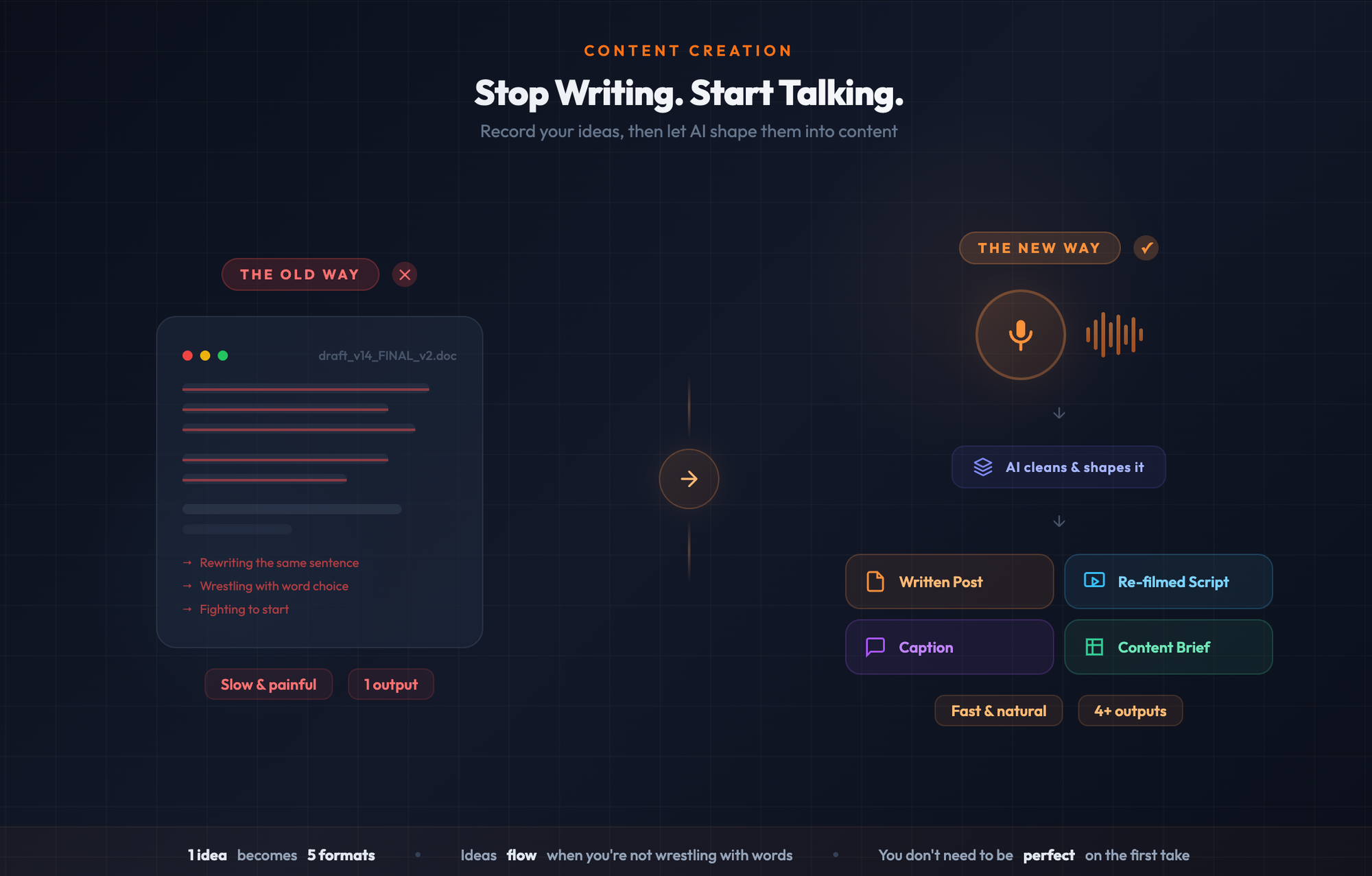
Everything changed when I started talking instead. Voice memos, voice-to-text, camera on. The ideas just flow when you're not wrestling with sentence structure. And you don't have to be perfect on the first take.
This is one of my favorite hacks: I record whatever comes to mind — either as a video or a voice-to-text — and then I use AI to help me clean it up and shape a script or outline. Tools like Descript let you edit video by editing text, which makes the whole process dramatically faster.
One recording can become a written post, a content brief, a script you re-film, a caption. You don't need five ideas. You need one idea and five formats.
Use the invisible interviewer technique.
This one is subtle but it changed how I record. It's a trick borrowed from video production called the "invisible interviewer" technique. Instead of just rattling off points to the camera, you imagine someone just asked you a question — and then you restate the question in your answer.
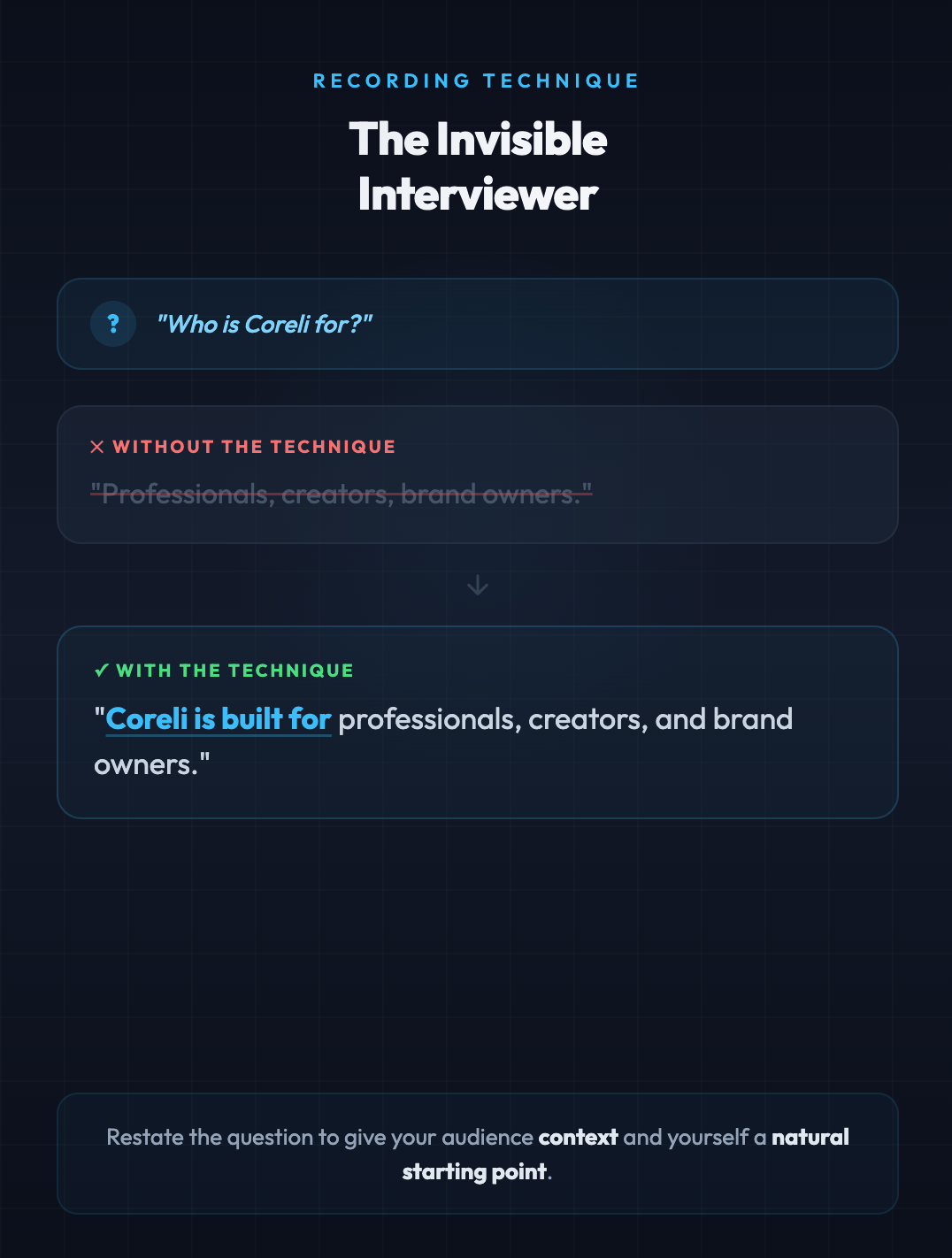
Say someone would ask you "Who is Coreli for?" Instead of just saying "professionals, creators, brand owners" — you'd say "Coreli is built for professionals, creators, and brand owners." Or if the question were "What helped you post more consistently?" — you wouldn't jump straight into a list of tips. You'd say "The biggest thing that helped me post more consistently was learning to think smaller."
It works because restating the question gives your audience context they'd otherwise miss. It also gives you a natural starting point every time you hit record. No more staring at the camera wondering how to begin.
Another prompt that works: ask yourself "Why am I making this video?" When you answer that honestly, the content practically writes itself.
Stop waiting for something worth saying.
This is the pattern I see most. People feel like they need some big milestone — a launch, a win, a career moment — before they have something interesting to share. They're waiting for permission.
My wife Julia has said the same thing. We've had a recent goal to get on podcasts as guests, but she's been hesitant because she felt like we didn't have anything big enough to say yet. She wanted to wait until we had some big launch to announce (this was before Coreli). But we've been publishing content at an elite level for fifteen years. There are countless insights we could share right now — and the same is probably true for you.
The truth is, you don't need a big moment. The fifteen years of doing the work — that's our BIG story. The small decisions, the things we learned the hard way, the stuff that seems obvious to us now but isn't obvious to someone two steps behind us. That's what people actually want to hear.
If you have something impressive to say, that's great. But even then — don't just lead with the accomplishment. Connect it to something relatable. Tell the story of how you got there, or what it felt like along the way, or what you almost got wrong. That's what makes people lean in. Not "I launched a rocket to Mars" but "here's the moment I almost quit before we figured it out."
Daniel Priestley has a great video on this that I'd really encourage you to watch. His technique for finding stories to tell is probably the best one I've heard — no blank notebook, no staring at the ceiling. He calls it "pause, reflect, document." You open your phone's camera roll, scroll month by month through the last few years, and look for moments that contained a lesson. A problem you solved. A result you got. A hard decision you made. The stories are already there. You've been living them. You just haven't turned them into posts yet.
The bottom line.
The people who post consistently aren't the most creative. They just made the process easy enough to not quit. Talk first. Think smaller. Post it.
That's the whole idea behind the Press Publish Challenge — seven days, seven posts, zero overthinking. It starts Monday, March 24th. You get a prompt every morning at 7am, a different format each day, and one simple rule: don't miss two days in a row.
If any of what I shared here resonated, this is the week to put it into practice. Comment "IN" on our @coreli.ai announcement post or join the group here to get the daily prompts.
See you Monday.
— Thomas