How to Make More Money as a Creator on ShopMy — Without Linking More
TL;DR - Stop linking everything. Go deep on ~10 products you know sell. People need to see something ~7 times before they buy — most creators link once and move on. Track your Earnings Per Click (EPC) to find which retailers actually pay you for the attention you drive. Prioritize direct brand partners (2–3X higher commissions). Use trust language, not ad language. ~26% of our orders use a discount code — get codes from brands you link consistently. Watch your return rates — gross earnings ≠ net earnings. And if you're small, go micro: DMs and story replies convert better than broadcasts.
Julia and I started using ShopMy in September 2024. It took a while for them to sell us on it. There were pitches, cold emails, and plenty of "why is this different?" conversations. The thing that finally clicked: ShopMy built a product that brands actually wanted to use because they were given the ability to see which influencers were performing for them, how to efficiently get product in their hands and how to scale. And when brands show up with money, the environment gets better for creators too.
Over 15 years of affiliate linking to fashion, beauty and home products, we've learned a lot about what moves the needle on affiliate earnings. Most of it comes down to one shift: stop trying to link everything and start going deeper on what already works.
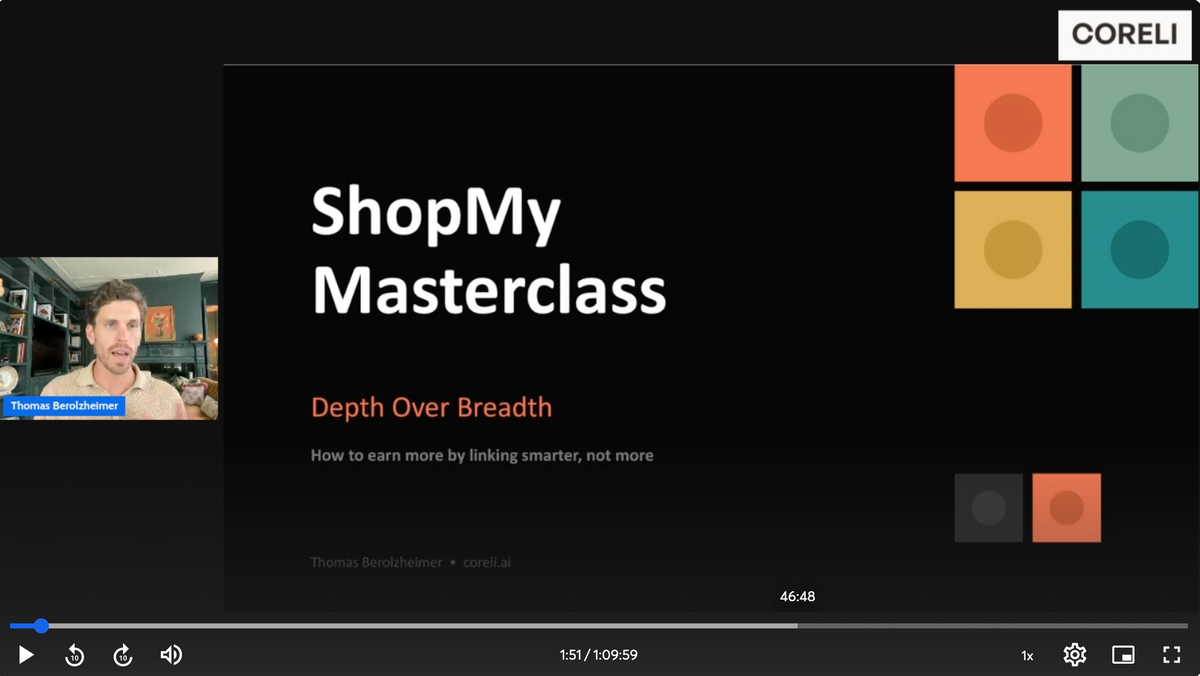
I recently hosted a live masterclass breaking all of this down. This post covers every framework, metric, and tactic from that session — plus the slides. Whether you're earning your first commissions or trying to double what you made last quarter, the strategy is the same: link smarter, not more.
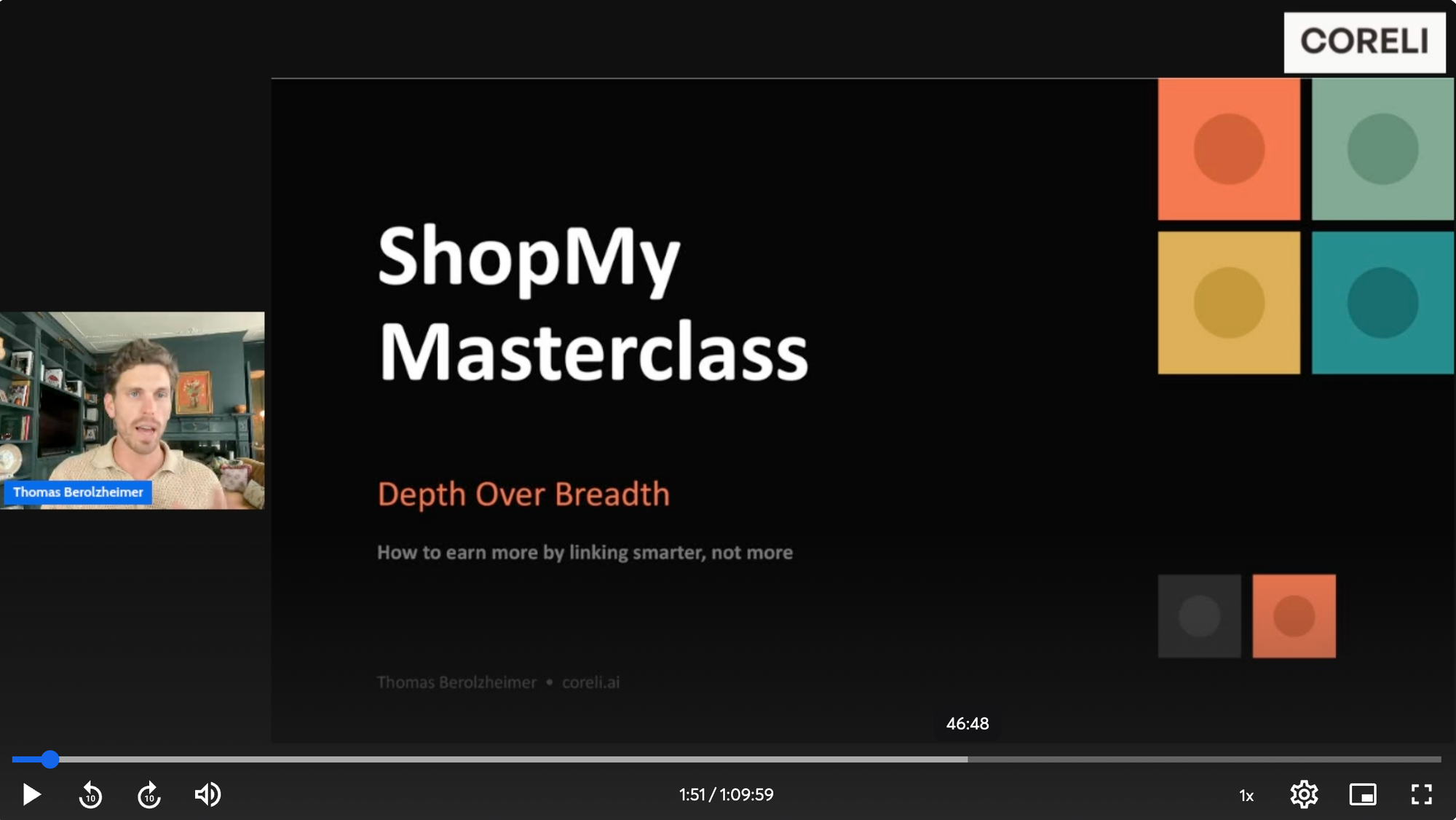
The full breakdown — with charts, data tables, and frameworks — is below.
What's in this post
- The Big Idea: Depth Over Breadth
- Three Questions That Drive Earnings
- Two Tracks — Pick the One That Fits
- The Metrics That Actually Matter
- Earnings Per Click (EPC) — Your Most Important Number
- Earnings Per Link — Are You Creating Too Many?
- Direct Brand Partners: 2–3X Higher Earnings
- The Older Sister Test: Trust Language That Converts
- Discount Codes: ~26% of Our Orders
- Cookie Windows and Why Urgency Matters
- The Return Rate Blind Spot
- Go Micro When You're Small
- Use AI as Your Analyst
- Platform Strategy for 2026
1. The Big Idea: Depth Over Breadth
Most creators treat affiliate linking like a volume game. New product, new link, new story, repeat. The problem is that this approach spreads your effort thin and teaches your audience to ignore you.
The strategy we've shifted to is the opposite: pick fewer products and go deeper on each one. Three principles drive this.
The 7x Rule
People need to see something roughly 7 times before they buy. Most creators link once and move on. That's leaving 6 more chances on the table.
Single Product Focus
Link one SKU, not a collection. More options means more hesitation, which means fewer sales. Make the decision easy.
Trust Over Volume
Your audience buys because they trust you. Every low-conviction link erodes that trust. Be selective about what you put your name behind.
This doesn't mean you never link new products. It means you have a core roster — maybe 10 items — that you know convert and that you keep coming back to in different formats and contexts. The new stuff supplements. The core earns.
2. Three Questions That Drive Earnings
Every affiliate decision you make maps to one of these three questions. If you can answer all three well, you'll earn more from the same amount of content.
- What do I link?
Product selection — your data + network trends
- Where do I link?
Retailer choice — which stores convert for YOUR audience
- How do I close it?
Placement, trust language, timing, codes
Most creators only think about question one. But questions two and three are where the earnings differences show up. You could be linking the right product to the wrong retailer — or saying the right thing at the wrong time. The rest of this post breaks down how to get each one right.
3. Two Tracks — Pick the One That Fits Where You Are
Not every creator is in the same place. If you have volume and data, the approach is different than if you're still building your audience. Pick the track that fits.
Data-Driven- For creators with volume
- Export last 3 months of commissions
- Filter to retailers with 200+ clicks
- Calculate EPC, earnings per link, return rates
- Use conditional formatting to spot patterns
- Use AI to find insights in your exports
Trust-FirstFor creators still building
- Pick ONE product you're obsessed with
- Make 5–7 pieces of content about it
- Go micro: DMs, story replies, personal recs
- Be the older sister, not the salesperson
- Build trust before you chase data
If you're somewhere in between, start with the Trust-First track and layer in data as your numbers grow. The fundamentals are the same either way: go deep, not wide.
4. The Metrics That Actually Matter
ShopMy shows you four things: clicks, orders, commission earned, and order volume. Those are useful but incomplete. Here are the five metrics you should be calculating yourself — they'll tell you where to focus and what to cut.
Five metrics to calculate from your ShopMy data
Earnings Per Click (EPC) = Earned ÷ Clicks — your most important metric. How much is each click actually worth?
Earnings Per Link (EPL) = Earned ÷ Links Created — are you creating too many links? Fewer links with higher EPL means you're focused.
Conversion Rate = Orders ÷ Clicks — are your clicks turning into sales, or just window shopping?
Commission Rate = Earned ÷ Sales Volume — are you getting paid fairly for the revenue you drive?
Average Order Value (AOV) = Sales ÷ Orders — what price point are you converting at? Higher AOV usually means higher commissions per sale.
If you only track one thing, track EPC. It answers the most important question: which retailers actually pay you for the attention you drive?
5. Earnings Per Click — Your Most Important Number
EPC tells you which retailers are worth your time and which ones are costing you attention for almost nothing. Here's an example of how this looks when you color-code your data:
The rule of thumb: filter to retailers with 200+ clicks, then sort by EPC. Anything below $0.20 is costing you attention for almost nothing. That attention is better spent going deeper on your green-zone retailers.
Built for ShopMy creators
Your ShopMy links need a permanent home.
Coreli pulls in your ShopMy outfits automatically. Every new post you create shows up on your page — always on, always shoppable, always earning.
Stories disappear. Feed posts get buried. Your Coreli page doesn't.
See what your page could look like →6. Earnings Per Link — Are You Creating Too Many?
This metric is the clearest signal of whether you're focused or spread thin. If you're creating 50+ links to a retailer and earning $14 per link, that effort is better spent going deeper on your winners.
The creators earning the most per link are the ones who link with intention. They're not trying to cover every product — they're making 3 to 8 links count by going deep with content, context, and trust behind each one.
7. Direct Brand Partners: 2–3X Higher Earnings
One of the easiest ways to earn more from the exact same links: pay attention to which retailers are direct brand partners on ShopMy. We've confirmed with the ShopMy team that direct partners pay 2–3X higher commissions than network-based retailers.
Here's why. In the old affiliate model, there's a chain: Brand → Agency → Affiliate Network → Retailer → You. Every middleman takes a cut. With direct partners on ShopMy, it's just: Brand → ShopMy → You.
Why direct partners pay more
Better tracking — Direct integration means fewer lost sales and more accurate attribution.
Faster attribution — Sales are credited faster, so there's less cookie risk from other creators overwriting your link.
Higher commissions — Without middlemen, more of the brand's budget reaches you.
Look for the "Partner" label in ShopMy. When you see it, that retailer is worth prioritizing.
There's a bigger market shift happening here too. Ad costs on Google and Meta keep rising. Cookie tracking across the web is disappearing. Brands are moving budget toward creator partnerships where they can measure real ROI. Direct partners on ShopMy are at the front of that shift — and they're paying creators more because they can see exactly what you drive.
And when you prove you can sell? The paid opportunities come to you. Brands see your performance data, and that becomes your pitch. Conversion first — deals follow.
8. The Older Sister Test: Trust Language That Converts
We've adopted a framing internally called the Older Sister Test. The question: would you text your younger sister about this product, unprompted?
The difference between language that sounds like an ad and language that sounds like a trusted friend is the difference between a scroll-past and a sale. Here's what the contrast looks like:
The right column works because it contains specificity and personal experience. It's not hype — it's proof that you actually use the thing. When you go deep on a small number of products, this kind of language comes naturally because you're speaking from real experience.
9. Discount Codes: ~26% of Our Orders
~26% of Julia's orders use a discount code
That's a real stat from our own data. When roughly one in four of your orders involves a code, it's worth paying attention to.
Why codes matter beyond the obvious conversion boost: codes are tied to you specifically, so they can't be overwritten by another creator's cookie. They have built-in urgency through expiration dates. They give your audience a reason to buy now instead of later. And they make it easier for brands to track your impact, which leads to better terms down the road.
How to get codes: go deep on a small number of brands. When they see consistent linking from you in their ShopMy dashboard, most will say yes when you ask for a code. Check your commission export to see which brands' codes get the most use, then ask those brands for a refreshed code with better terms.
10. Cookie Windows and Why Urgency Matters
Here's something most creators don't think about: every creator linking to the same retailer can overwrite your cookie. If someone clicks your link on Monday and another creator's link on Wednesday, the Wednesday creator gets the commission — even if your content was the reason they found the product.
This is why your content needs to drive immediate purchases. Not next week. Not "I'll think about it." Now.
Four tactics that work without feeling pushy:
- Limited inventory — "Only 3 left in my size"
- Price anchoring — "This never goes on sale"
- Personal urgency — "I'm buying a second before it sells out"
- Discount codes — Tied to you, can't be overwritten, built-in expiration
All of these pass the Older Sister Test. They're the kind of things you'd actually say to a friend if you thought they should act fast.
11. The Return Rate Blind Spot
ShopMy shows your earnings as the gross number — before returns. In fashion especially, this can paint a misleading picture of what you're actually taking home.
Here's an example of why this matters:
| Luxury Retailer | Trusted Shop | |
|---|---|---|
| Gross Earned | $8,770 | $2,304 |
| Return Rate | 32% | 8% |
| Net Earned | $5,964 | $2,120 |
| Net EPC | $0.96 | $1.18 |
The Luxury Retailer looks like the clear winner at the gross level — $8,770 vs. $2,304. But after a 32% return rate, the net EPC ($0.96) is actually lower than the Trusted Shop ($1.18). If you're optimizing on gross numbers alone, you might double down on the wrong retailer.
How to track your return rate
Export your commissions today. Then re-export the same period in 60–90 days. The gap between the two is your return rate. Track this over time and it'll tell you which retailers have high-return products — and which ones are truly earning you what the dashboard says.
12. Go Micro When You're Small
If you're a smaller creator, you have something bigger accounts don't: intimacy. One-on-one interactions convert better than broadcasts. Use that.
Answer story replies with a linkSomeone responded — that's a warm lead handing themselves to you.
DM product recs to people who ask- One-on-one recs have almost zero cookie competition.
Be a personal shopper"- What sunscreen?" → Send 3 options with your links and a one-liner on each.
Do the research for people- Go deeper than anyone else would. That effort builds trust that scales.
This approach doesn't scale the way a reel does. But the conversion rates are dramatically higher, and it builds the kind of trust that makes everything else work better over time.
13. Use AI as Your Analyst
You can export your ShopMy commission data (Earnings → Commissions → Export) and drop it straight into Claude or ChatGPT. Here are three prompts we use to pull insights from the numbers:
1. Find My Winners
"Here's my ShopMy commission data. Show my top 10 products by earnings per click. Group by retailer and category. What patterns do you see?"
2. Price Sweet Spot
"Group products into price bands: $0–50, $50–100, $100–200, $200+. Which band has the highest conversion rate and total earnings? What product in the $75–100 range shows the most potential to link again?"
3. Predict What to Link Next
"Imagine you're a top consulting analyst. Use my data to tell a story about how I'm going to double my affiliate commissions over the next 3 months. Use my top brands, categories, and price points. What should I link more? What should I stop linking?"
The export gives you the raw numbers. AI gives you the patterns and the plan. You don't need a data analyst — you just need to ask the right questions.
14. Platform Strategy for 2026
Think of Instagram as a funnel. Reels are the top — that's where new people find you. Carousels sit in the middle. Stories are the bottom — your existing audience, the people who already trust you and are most likely to buy.
We analyzed our own data and found that 6 to 10 stories per day is the sweet spot. After that, you start fatiguing your audience. If you need to post more (big day, travel, launch), post a batch of 6–10 in the morning, wait a few hours, then post another batch. People check Instagram throughout the day, so they'll catch the second batch in a later session.
One tactic that converts well: when Julia posts an outfit and doesn't tag anything, she gets comments asking where specific items are from. We screenshot those comments and turn them into a follow-up story — the product photo with comments sprinkled around it. Social proof like that creates urgency.
On reach: it's down for almost everyone. My advice is to stop worrying about it. Figure out who you actually want buying from you and make content for them. Call them out in your hook. Focus on conversion, not impressions.
YouTube
I'm leaning toward YouTube this year. The longer someone spends with you, the more they trust you. I'm already posting two and three-minute reels on Instagram. YouTube is the natural next step — more time together, more trust, more sales.
We used Pinterest heavily during the Gal Meets Glam era and it still drives traffic. I've heard Amazon performs particularly well with Pinterest linking. If it fits your content style, it's worth testing.
Blogs
People ask us every day whether blogs still make sense. We still think of ours as one of our most important platforms. But the bar is higher now. A blog in 2026 needs something unique — a feature, an experience, a reason to come back. Otherwise, your audience has no reason to leave the platforms they're already on.
The Bottom Line
The biggest shift we've made isn't about working more. It's about going deeper on what's already working. Pick your products. Track your EPC and your return rates. Use trust language, not ad language. Prioritize direct brand partners. And let the compounding do its thing.
Most creators are stressed because they're spread across too many platforms, too many products, too many brands. The path to more earnings isn't more links. It's better links, linked more often, with more conviction behind them.
Depth over breadth. Link smarter. Go deeper. Earn more.
Your links deserve a permanent home
Stories disappear. Feed posts get buried. Coreli builds a page from your content that's always on, always shoppable — and it syncs with ShopMy automatically.
Free to build. No credit card until you publish.