What 15 Years of Affiliate Strategy Taught Me (And Why We Built a Referral Program)
By Thomas Berolzheimer
T.L.D.R; Coreli's creator referral program pays 10% cash up to $50 on every signup you refer—no application, no credits, no tiers. Here's why we built it, how it works, and what 15 years behind the scenes of affiliate strategy taught me about turning trust into income.
If you use a link in bio tool, you probably think of it as a utility. Somewhere to park your links. A necessary thing, but not something that earns you money on its own.
I used to think the same way. Then I spent 15 years managing affiliate and referral strategy for my wife Julia Berolzheimer's brand—across ShopMy, Amazon's, Collective Voice (now defunct) influencer programs, and dozens of hundreds of brand partnerships—and one pattern kept showing up.
Every link your audience clicks is a vote of trust. That trust has real, measurable value. And many creators leave it sitting on the table.
Here's the data to prove it: 92% of consumers trust recommendations from people they know over any other form of advertising. Referred customers are 4x more likely to buy. And simple referral programs convert 2.6x better than complex ones.
That's why we built a referral program into Coreli—not as a nice-to-have, but as one of the first features we launched. This post breaks down the thinking behind it and shows you how to put it to work, whether you're already familiar with affiliate programs or hearing about one for the first time.
What You'll Learn in This Post
- What a referral program actually is (and why most get it wrong)
- How Coreli's referral program works—the full breakdown
- The ecosystem mindset that separates top earners from everyone else
- How to use your referral link at every audience size
- 5 low-effort ways to start earning this week
- Why we designed it the way we did
- FAQs about the Coreli referral program
What Is a Creator Referral Program?
A referral program is straightforward: you share a special link. When someone signs up through that link and becomes a paying customer, you earn a percentage of what they pay. It's word-of-mouth, formalized—and it works.
Referral marketing generates 3–5x higher conversion rates than paid advertising. That's because recommendations carry trust that no ad can replicate.
You've probably seen referral programs before with other tools. But here's what makes most of them frustrating:
Where Most Referral Programs Fall Short
- They pay in credits, not cash. You earn "$50 in platform credit" that you can only spend inside their product. That's not income. That's a coupon.
- They require an application. You fill out a form, wait for approval, and maybe hear back in two weeks. By then you've moved on.
- They make it complicated. Tiers, thresholds, minimum payouts, 90-day cookie windows. It shouldn't take a spreadsheet to figure out what you'll earn.
- They bury the link. Most platforms don't surface the referral option until you go looking for it. If you don't know it exists, you can't use it.
We wanted to do something different. The data backed us up: simple referral programs convert 2.6x better than complex ones.
How Coreli's Referral Program Works
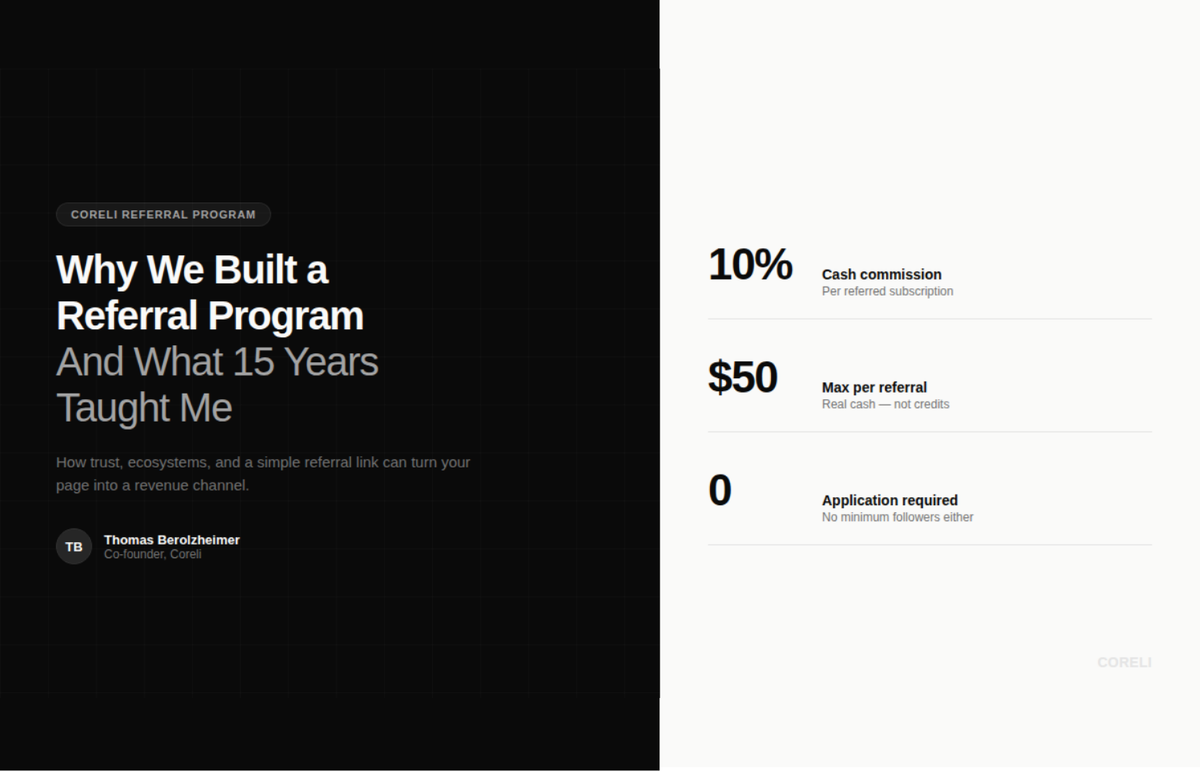
When someone signs up through your referral link and subscribes to Coreli, you earn 10% of what they pay—up to $50 per person. Real cash.
That's it. Here's the full breakdown:
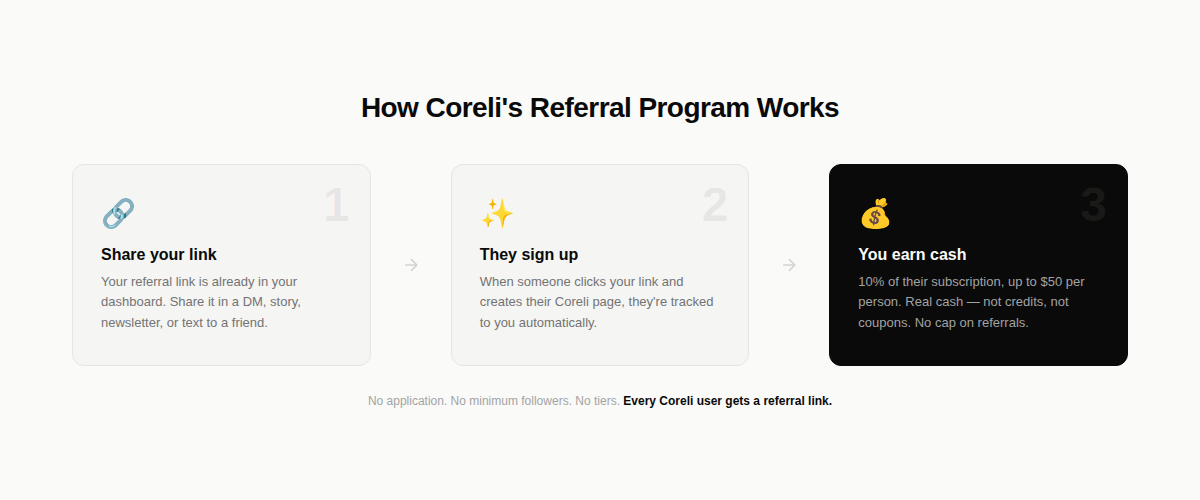
Your referral link is already in your Coreli dashboard. You don't need to apply, you don't need to ask, and you don't need a certain number of followers. If you have a Coreli page, you have a referral link. Even if you haven't even published it or become a paying member.
The payout structure is intentionally simple because we've seen what happens when it isn't. People don't share things they don't understand. We wanted this to be something you could explain to a friend in one sentence: "Sign up through my link and I earn 10% of your subscription, paid in cash."
Log in to your Coreli dashboard and find your referral link →
The Ecosystem Lesson That Took 15 Years to Learn
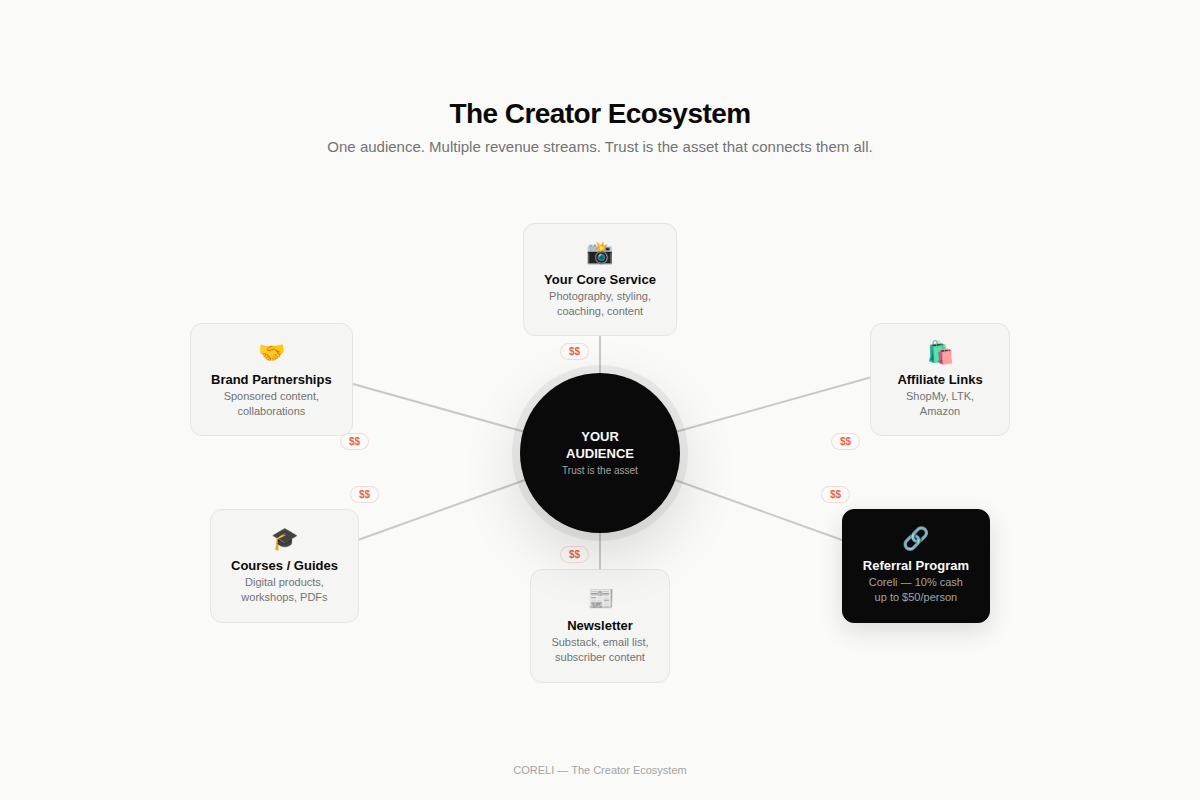
I've managed affiliate relationships with ShopMy, LTK, Amazon's influencer program, and hundred of brand partnerships. After doing this long enough, one pattern becomes impossible to ignore:
The creators who earn the most aren't the ones with the biggest audiences. They're the ones who think in ecosystems.
Let me explain what I mean.
The Travel Agent Example
There's a travel agent on Coreli. Her main business is booking trips. That's how she earns the majority of her income. But on her page, she also links to her travel essentials—luggage, packing cubes, her favorite carry-on bag.
Think about that for a second. If you trust someone enough to book a $5,000 trip through them, of course you'd trust their packing list. She didn't have to sell you on the packing list. You were already sold on her.
That's the ecosystem. One audience, multiple ways to deliver value, multiple revenue streams. The trust is the asset. Everything else flows from it.
This pattern holds up in the data. Nearly 70% of creators now run more than one income stream, and those with 3 or more revenue streams report significantly better financial stability.
Why This Works for Photographers, Stylists, and Coaches Too
Photographer Eric Kelley understood this right away. He was one of the first people to share his Coreli referral link, and he started getting signups almost immediately. He didn't do a big promotional push. He just mentioned it. His audience already trusted him, and when he said "if you've been using Linktree, you need to use this instead," people listened.
The same ecosystem logic applies to stylists, wellness coaches, fitness instructors, physical therapists—anyone whose audience already trusts their taste or expertise. Your recommendation carries weight because your audience chose to follow you in the first place.
Why Your Link in Bio Is a Revenue Channel
Your Coreli Link in Bio page is where your audience goes after they see your content. It's where attention turns into action—booking a session, clicking a product link, reading your newsletter, or finding out what you're about.
The numbers reflect this shift. 43% of social media referrals come from Instagram, and 80% of consumers take action after seeing creator content. Your link in bio is already the place where trust converts. The question is whether you're capturing value from it.
Now add referrals to that picture. When a friend or follower asks you what tool you use for your page, you already have an answer. Your referral link turns that conversation into a small but real revenue stream. No extra work. No content to create. Just an answer you were going to give anyway.
Alex Hormozi puts it well: even if you're not the one providing a service, you should set up referrals with the services you trust. If your audience trusts you, that trust applies to everything you recommend—not just the products you sell directly. Hormozi also points out the biggest reason people don't get referrals isn't that the product is bad—it's that they simply never ask.
You don't need to create a whole campaign around your referral link. You just need to use it when the moment is natural.
This Works at Every Audience Size
One thing I want to be clear about: you do not need a big following for this to work.
If you're a photographer with 2,000 followers, and three of your photographer friends sign up through your link, that's worth it. If you're a physical therapist and you mention Coreli to another PT, that counts. If you're a stylist and your client asks how your page looks so good, your referral link is the answer.
The beauty of a referral program is that it works at every scale. Big audiences drive volume. Small audiences drive trust. Both convert. In fact, 49% of all first-time purchases are based on a friend's recommendation—not an ad, not an algorithm, but a real person saying "you should try this."
Referral Strategies by Audience Size
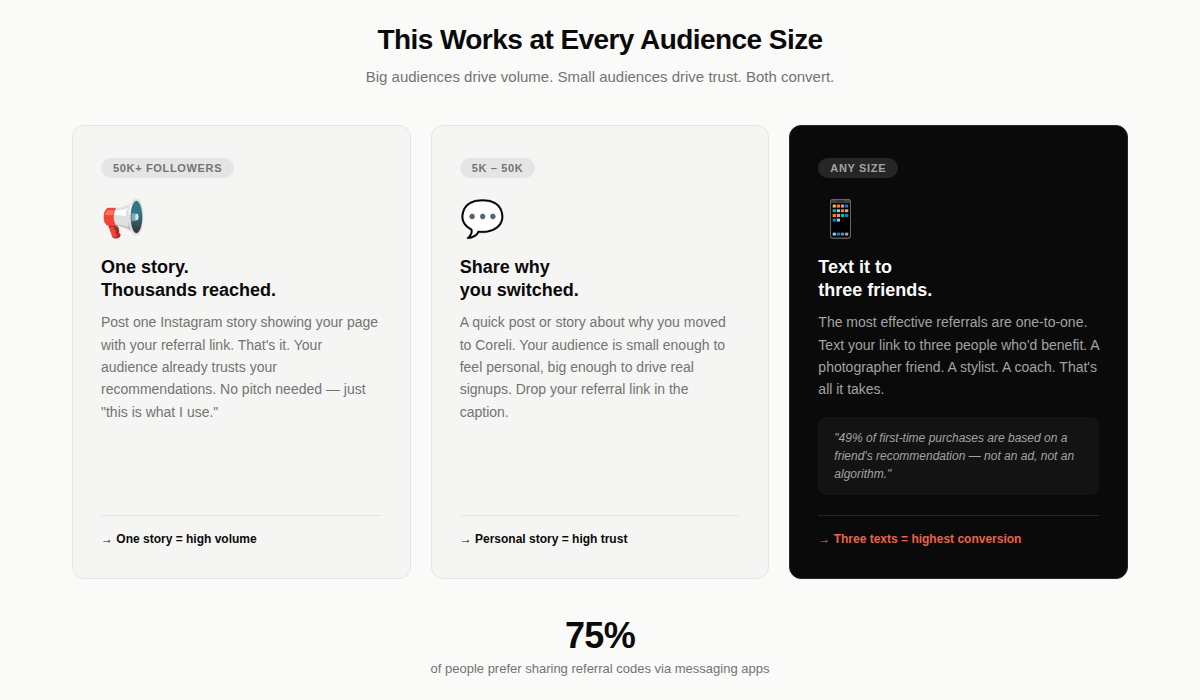
The most effective referrals aren't broadcasts—they're one-to-one recommendations sent to a specific person. A direct text to a friend who'd benefit is worth more than a story that reaches thousands.
5 Ways to Start Earning with Your Referral Link
You don't need to run a campaign. You don't need to make a dedicated post. Here are five low-effort ways to put your referral link to work this week:
1. When Someone Asks About Your Link in Bio
This happens more often than you think. Instead of saying "I use Coreli," send them your referral link. Same recommendation, but now you earn from it. One-click sharing alone increases referral activity by 26%.
2. Drop It in a Story Once a Month
Something like: "I rebuilt my link in bio with Coreli and I'm still obsessed. If you want to try it, here's my link." That's enough. Social proof in referral posts boosts conversions by 19%, and your page is the proof.
3. Share It Directly in a DM
If you know someone who's been complaining about their Linktree or looking for something better, send them the link directly. Personal recommendations convert better than anything—referred leads convert 30% better than leads from any other channel.
4. Include It in Your Newsletter or Substack
One line at the bottom: "I use Coreli for my link in bio—try it here."
5. Mention It in a Group Chat or Community
Creator communities, industry Slack groups, or even a group text with friends in your field. When someone asks for tool recommendations, drop your link.
The common thread: you're not selling. You're sharing something you already use. Your page is the proof. The referral link just makes sure you get something back when people act on your recommendation.
Why We Designed It This Way
Chloe and I talked a lot about what this program should feel like. We kept coming back to the same idea: it should feel like a recommendation, not a sales pitch.
That's why we didn't add tiers, badges, or leaderboards. We didn't build a dashboard full of widgets. We just gave you a link and a simple promise: when someone signs up through your link and subscribes, you earn 10% of what they pay, up to $50 per person. Cash.
We also decided early on that this wouldn't require an application. Every Coreli user gets a referral link. No minimum follower count, no approval wait, no content requirements. If you have a page, you can refer.
Simple referral programs convert 2.6x better than complex ones.
The best referrals don't come from people with the biggest audiences. They come from people whose friends trust them. And everyone has those.
Frequently Asked Questions
How much can I earn with the Coreli referral program?
You earn 10% of what each referred user pays, up to $50 per person. There's no cap on the number of people you can refer. If ten people sign up through your link and subscribe, you earn from all ten.
Do I need to apply or get approved?
No. Every Coreli user automatically gets a referral link in their dashboard. No application, no approval process, no waiting period.
Is it paid in cash or credits?
Cash. We don't do credits. You earn real money.
Do I need a large following to make referrals work?
Not at all. Research shows that 49% of first purchases are driven by a friend's recommendation. Three texts to the right people can generate more signups than a story seen by thousands.
How do I find my referral link?
Log in to your Coreli dashboard. Your referral link is already there in the bottom right hand corner, ready to share.
Can I share my referral link on social media?
Yes—Instagram stories, posts, captions, newsletters, DMs, group chats, or anywhere else. There are no restrictions on where you share it.
Ready to Get Started?
Your referral link is already in your Coreli dashboard. You don't need to do anything to activate it.
If you know three people who'd benefit from a beautiful page for everything they do, send them your link this week. That's it. No elaborate strategy. Just three people who'd appreciate the recommendation.
Your page is already the best proof that Coreli works. The referral program just means you get something back when people agree.
— Thomas