ShopMy vs LTK: Which Affiliate Platform Is Right for You? (2026 Guide)
ShopMy and LTK both help creators earn from product recommendations. But they work differently, pay differently, and fit different creators. Here's how to decide which one deserves your time.

Two platforms, two philosophies, one question.
TL;DR
The honest ShopMy vs LTK comparison for Instagram creators: ShopMy is a toolkit (open access, weekly payouts, transparent brand data). LTK is a marketplace (40M+ monthly shoppers, managed brand campaigns, 60-90 day payout window). Start with ShopMy if you're under 5K followers. Apply to LTK once you qualify. Most successful affiliate creators end up using both. ShopMy for day-to-day linking, LTK for Quick Collabs and app-based discovery.
Key takeaways: ShopMy vs LTK at a glance
- ShopMy is a toolkit (open access, weekly payouts, transparent brand data) built around individual creator-brand relationships.
- LTK is a marketplace (application-based, biweekly payouts, in-app audience) that drives intent-driven shoppers through its own app.
- ShopMy wins for creators under 5,000 followers, web-first audiences, and creators who want brands to find them via real-time data.
- LTK wins for creators over 5,000 followers, in-app shoppers, and creators who want curated brand partnerships from LTK's team.
- ShopMy pays every Friday; LTK pays biweekly with 60-90 day commission close windows.
- Most established creators use both. Run product links on ShopMy for speed and use LTK for in-app discovery.
If you're an Instagram creator making money from product recommendations, you've heard the debate. ShopMy or LTK? Creators are switching platforms, posting threads about why they left one for the other, and brands are shifting budgets between the two.
Most of the takes miss the point. This isn't about which platform is objectively better. It's about which one is right for how you work, what you sell, and where you are in your creator journey.
I've spent the last two years watching both platforms from the inside. My co-founder Thomas and his wife Julia Berolzheimer have been in the affiliate space for over 15 years, including deep experience with both ShopMy and LTK. At Coreli, we integrate with ShopMy directly and see how creators use these platforms in practice every day.
Both platforms shipped major updates in early 2026. This comparison reflects where they stand right now, not six months ago.
What is the core difference between ShopMy vs LTK?
LTK is a marketplace. ShopMy is a toolkit.
That one sentence explains most of the differences between the two. LTK built a shopping app with over 40 million monthly users where consumers browse and buy through creators they follow. When you join LTK, you're entering an ecosystem where shoppers come to you through the app itself. ShopMy built a set of tools that make affiliate linking faster, more transparent, and more flexible. Your audience comes from your existing channels, and ShopMy handles the infrastructure behind the scenes.
Neither approach is wrong. But they serve different strategies, and understanding which one maps to yours is the whole game.
Who can join
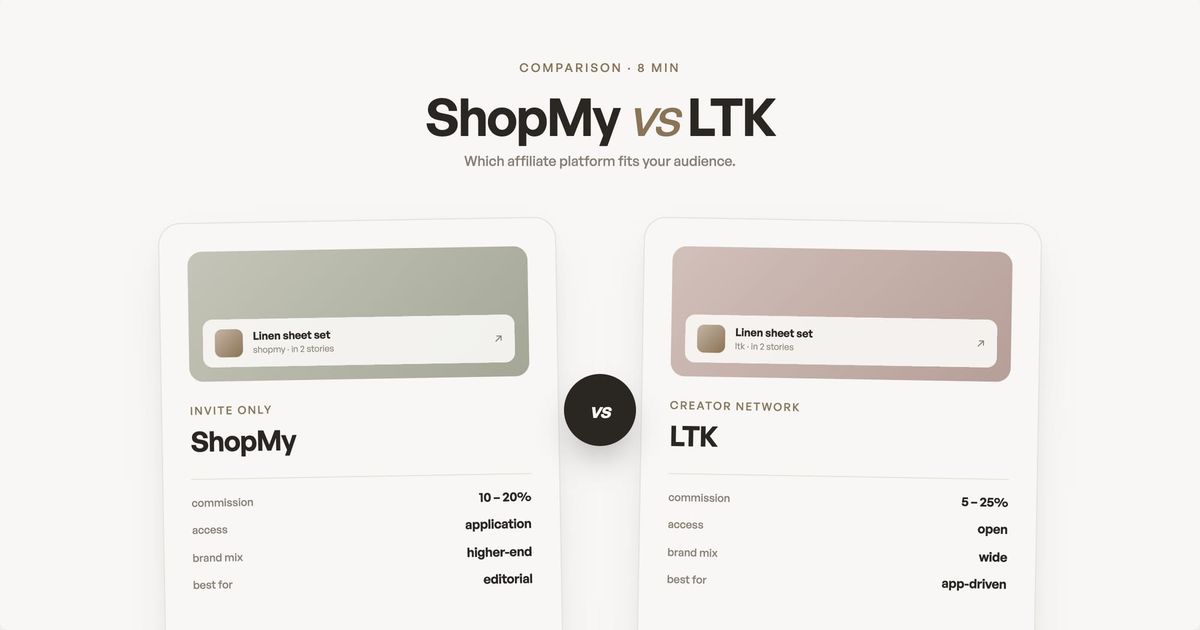
ShopMy is open to all creators. No follower minimum, no formal application process. You sign up, build your storefront, and start linking. The platform now has over 200,000 creators and was named to Fast Company's Most Innovative Companies list for 2026.
LTK requires an application. They're looking for creators with an engaged and growing audience of at least 5,000 followers on a public social profile, posting high quality content at least twice a week. LTK has been expanding access to smaller creators, but the barrier to entry is real. If you're under 5K followers, you're probably not getting approved right now.
If you're early in your creator journey, ShopMy is where you start. No debate.
Commission rates
This is the question everyone asks first, and the answer is more nuanced than a single number.
ShopMy commissions typically range from 10% to 30% depending on the brand. The platform has a four-tier system (Enthusiast, Ambassador, Trendsetter, Icon) that rewards active creators with bonuses and increased visibility, but your base commission rates come from the brands and retailers themselves. One of ShopMy's strongest features is that you can add your own external affiliate links from brands you work with directly, which means you can earn higher rates from your direct relationships while still managing everything in one dashboard.
LTK commissions typically range from 5% to 25%, with the average brand commission rate sitting around 16% according to LTK's own documentation. LTK recently rolled out a Product Commission Comparison tool that lets creators see all available rates for a product and choose the best-paying retailer. With their new Quick Collabs feature (launched March 2026), creators can also earn flat-fee payments on brand campaigns and get paid within 48-72 hours of posting, which is a meaningful addition beyond pure commission income.
The real difference isn't the rate range. It's what happens behind the scenes. ShopMy's direct brand partnerships pay 2-3x higher commissions than network-based retailers because there are fewer middlemen in the chain. When a brand partners directly with ShopMy, the path is Brand to ShopMy to You. On LTK's network model, there can be additional layers between you and the brand, and every layer takes a cut.
How you get paid
ShopMy pays every Friday via PayPal or Stripe. If you've ever waited months for commissions to close on other platforms, this alone might be enough to switch. The weekly payout cycle means you see the results of your work almost immediately.
LTK pays every two weeks via PayPal and, as of mid-2025, also via direct deposit. The catch: LTK commissions take significantly longer to move from "pending" to "closed" because retailers need time to process returns. Fashion has notoriously high return rates, so it's common for commissions to sit in pending status for 60-90 days before they're eligible for payout. LTK's new Quick Collabs feature helps here since flat-fee campaigns pay within 48-72 hours regardless of the return window.
Speed of payment matters psychologically. When you can see the connection between posting a product recommendation and getting paid for it within a week, it reinforces the behavior. When there's a three-month lag, the feedback loop breaks down.
Brand discovery and gifting
This is where the platforms diverge the most, and where both have made their biggest recent investments.
ShopMy gives brands real-time visibility into which creators are driving their sales. Brands can see exactly who made a conversion and how much revenue each creator generated. This transparency is the core reason brands are moving budget to ShopMy. The platform has a built-in gifting system (Lookbooks drove over $10M in gifting volume within six months of launch) and a Talent Card feature that displays your verified performance data (AOV, conversion rate, sales volume) to brands automatically. Instead of putting together a media kit PDF, your track record updates in real time. For creators who convert well but don't have massive followings, the Talent Card levels the playing field.
LTK's approach is more intermediated. Their brand partnerships team creates casting proposals and matches creators to campaigns. The new Target Ambassadors program (launched May 2026) is a good example of what this looks like at scale: a multi-tiered ambassador program built directly into the LTK Creator app with enhanced commissions, exclusive campaigns, and monthly bonuses. LTK is also investing in AI-powered casting tools that help brands find the right creators based on performance data. For established creators already on LTK's radar, this model can deliver substantial brand deal flow.
If building direct brand relationships is your priority and you want brands to find you organically through your data, ShopMy's transparency model works in your favor. If you prefer LTK's team to match you to campaigns, and you have the following to be competitive in those casting pools, LTK's managed approach delivers.
What's new in 2026
Both platforms shipped significant updates in the first half of 2026 and understanding the direction each is heading tells you a lot about which one fits your strategy.
- ShopMy's biggest moves: Noir (April 2026) is a personal shopping service where top spenders text real creator-curators for personalized product recommendations. Unlike AI chatbots, it's powered by actual humans with styling expertise, and curators earn commission on purchases. Circles lets shoppers group multiple creators into a combined storefront, and products saved to wishlists through Circles remain commissionable to the creator indefinitely, creating a genuine passive income layer. ShopMy also acquired Thingtesting in 2025, integrating verified product reviews directly into creator storefronts.
- LTK's biggest moves: LTK AI (February 2026) is an in-app chatbot trained on over a decade of creator content for personalized shopping recommendations. Quick Collabs (March 2026) lets creators opt into flat-fee brand campaigns and get paid within 48-72 hours. The app now features Visual Search (upload any image to find similar products on LTK), Public Profiles for consumers (making LTK more social), and two-way Chat for creators to start threaded conversations with followers. In April 2026, LTK hit a milestone: creators have now earned over $1 billion through the platform since its founding.
The pattern is clear: ShopMy is building toward becoming a shopping destination with human curation at its core. LTK is building toward becoming a social platform where shopping happens within community. Both are expanding beyond simple affiliate links into full creator commerce ecosystems.
The storefront experience
Both platforms give you a curated storefront where followers can browse your recommendations, but they're built on fundamentally different distribution models.
ShopMy's storefront is web-first. Your audience clicks a link, lands directly on the product page, and you earn. No app download required, no redirect friction. With the 2025 storefront revamp, creators get searchable shops with filters, wishlists, and the Thingtesting review integration. The Snapshop browser extension lets you convert any product URL into a commissionable link instantly.
LTK's storefront lives primarily within the LTK shopping app. The app has 40+ million monthly users, which is a massive built-in audience that ShopMy doesn't have. But there's a trade-off: you're asking your followers to download and use a separate app. LTK has responded to this friction by adding embeddable widgets for blogs and websites (product carousels, shop-the-post blocks), and their new Public Profiles feature makes LTK content shareable via URL outside the app. The Visual Search and AI-powered discovery features are designed to bring shoppers to you through the app even if they don't follow you on Instagram.
Web-first (ShopMy) wins for creators whose traffic comes from Instagram Stories, newsletters, and link-in-bio pages. App-first (LTK) wins for creators who want to tap into LTK's built-in shopper base for incremental discovery.
Tracking and attribution
Attribution determines whether you get paid for the work you do. Both platforms use cookies to track purchases, but the details matter.
LTK has a known limitation with Instagram: the in-app browser doesn't persist cookies the same way a regular browser does. If someone clicks your LTK link in Instagram, they need to make the purchase immediately within that browser session. If they close Instagram and come back to buy later through Chrome or Safari, you lose the attribution. LTK's own documentation acknowledges that conversion rates through Instagram are lower for this reason.
ShopMy handles this differently. Their tracking is web-first and designed around how people actually shop from Instagram. The links route through ShopMy's server which generates fresh tracking per click, reducing the chance of lost attribution.
Here's something most comparison articles don't cover: cookie competition. Every creator linking to the same retailer can overwrite your cookie. If someone clicks your link on Monday and another creator's link on Wednesday, the Wednesday creator gets the commission, even if your content was the reason they found the product. This is why getting your link infrastructure right matters so much. Discount codes help here because they're tied to you specifically and can't be overwritten.
Which one if you're just starting out
ShopMy. Open access, no application wait, transparent data, weekly payouts, and the ability to add your own affiliate links from any source. You can start earning immediately and build a track record that makes you attractive to brands through your Talent Card data.
Once you've built momentum on ShopMy and have the follower count and content quality that LTK requires, apply to LTK as well. Running both platforms is what most successful affiliate creators end up doing.
Which one if you're established
Use both. The creators earning the most from affiliate marketing aren't choosing one platform. They're using ShopMy for day-to-day linking (faster payouts, transparent attribution, direct brand relationships) and LTK for Quick Collabs campaigns, app-based discovery, and the sheer scale of 40M monthly shoppers. Some creators also use LTK's embeddable widgets on their blogs while using ShopMy for Instagram-driven traffic.
The strategic question isn't which platform to be on. It's where your links live permanently. Stories disappear. Feed posts get buried. Your affiliate content needs a home that's always on and always shoppable.
This is the problem we built Coreli to solve. If you use ShopMy, your outfits sync automatically to your Coreli page through our direct integration. Every new ShopMy post you create shows up in a curated, editorial layout that matches your Instagram aesthetic. If you use LTK, you can use Coreli's custom link feature in the Media section to showcase your LTK content with custom captions and CTAs. Either way, your audience taps your bio link and sees your latest recommendations, your reels, and your shoppable content in one place, not a list of buttons on a white background.
Whichever platform you earn on, your link-in-bio should do that work justice.
ShopMy vs LTK: a decision framework
Forget the feature-by-feature comparison for a second. Answer these four questions and you'll know which platform to prioritize.
- How many followers do you have? Under 5K: start with ShopMy. Over 5K: apply to both.
- Where does your audience shop? If your followers buy through links you share directly (Stories, bio link, DMs), ShopMy's web-first model fits. If your audience actively uses the LTK app, stay there and invest in that ecosystem.
- How important is speed of payment? If waiting 60-90 days for commissions to close frustrates you, ShopMy's weekly payouts change the experience. LTK's Quick Collabs (flat-fee, paid in 48-72 hours) offer a faster option on the LTK side for campaign work.
- Do you want brands to find you, or do you want to find brands? ShopMy's Talent Card and sales transparency means brands see your data and come to you. LTK's casting and managed campaigns (like Target Ambassadors) match you to opportunities through their partnerships team.
Most creators reading this should be on both platforms. Start with the one that fits your current situation, and add the other when it makes sense.
One more thing
Whichever platform you choose, your affiliate links need to live somewhere permanent. Not just in a Story that disappears in 24 hours. Not buried in a caption from two weeks ago.
Your link-in-bio is where your affiliate strategy comes together. If it's a generic list of buttons, you're leaving money on the table. If it's a curated, on-brand page that showcases your recommendations the way you'd want them seen, every tap from Instagram works harder.
ShopMy vs LTK: platform features at a glance
Both platforms ship a creator app, a storefront, and a brand-side dashboard. The features look similar on paper. The execution and surface area are where they diverge.
- Open enrollment: ShopMy yes (any creator, instant), LTK no (application review, follower minimum around 5,000).
- Storefront experience: ShopMy is web-first, LTK lives primarily inside the LTK app (40+ million monthly users).
- Commission rate range: ShopMy 10-30% by brand, LTK 5-25% with an average around 10%.
- Payout cadence: ShopMy every Friday, LTK biweekly with 60-90 day commission close windows.
- Brand discovery: ShopMy gives brands real-time creator data; LTK uses a managed brand-partnerships team that builds casting proposals.
- AI features: LTK shipped LTK AI (an in-app chatbot trained on a decade of shoppable content) in early 2026; ShopMy launched Noir (a personal shopping service for top spenders) in April 2026.
ShopMy vs LTK: user experience and creator interface
The day-to-day interfaces feel different in ways that matter once you're using either platform for a year. ShopMy treats creators as the user. LTK treats creators as one half of a marketplace where shoppers are the other half.
- ShopMy's app is built around link creation. The fastest action is 'paste a product URL, get a tracked link.' Brand data and earnings are visible up front.
- LTK's creator app sits alongside the consumer LTK shopping app. Creators post 'collections' that show up to LTK's in-app audience as well as via shared links.
- ShopMy's analytics show per-link clicks, earnings, and conversion rate by brand. You can sort and export.
- LTK's analytics show per-post engagement and earnings, with deeper aggregate dashboards. Brand-side reporting is what most established LTK creators rely on.
- ShopMy supports direct creator-brand DMs and gifting requests. LTK funnels brand outreach through its partnerships team.
ShopMy vs LTK: which platform handles analytics better?
If you're trying to grow affiliate revenue intentionally rather than passively, the depth and immediacy of analytics matter.
ShopMy gives creators near-real-time data on which links generated which sales. You see the brand, the product, the commission, and the timestamp within hours. This lets you iterate quickly: if a product post outperformed expectations, you can double down within days.
LTK's analytics are richer at the post and aggregate level but slower. Sales close on a 60-90 day window because LTK accounts for returns, which means the data you see today reflects activity from one to three months ago. Useful for long-term strategy, less useful for fast iteration.
Frequently asked questions
How do ShopMy vs LTK handle data privacy and creator data?
Both platforms collect standard creator and click data (impressions, conversions, payouts). ShopMy shares more of the brand-side data back with creators in near-real-time. LTK aggregates data and surfaces it through dashboards but doesn't expose individual brand spend the way ShopMy does. Neither platform sells creator personal data to third parties. Check each platform's privacy policy for current details on what's collected and retained.
What are the main challenges creators face on each platform?
On ShopMy: occasional brand commissions get adjusted or clawed back if a return rate spikes, and brand discovery is creator-initiated rather than agent-led. On LTK: the application bar is real (5,000+ engaged followers), commission close windows are 60-90 days, and the in-app browser cookie limitation means some Instagram-driven clicks don't attribute properly. Most creators run both for that reason: ShopMy for speed and visibility, LTK for the in-app audience.
How do ShopMy vs LTK integrate with Instagram and other social platforms?
ShopMy links can be placed directly in Instagram Stories, link-in-bio pages, newsletters, and any web destination. LTK works best inside its own app and in Stories via the LTK Creator Connect feature; in-app browser cookie limits can cause attribution gaps on Instagram bio link clicks. ShopMy is more flexible for cross-platform distribution. LTK is more powerful when your audience is already inside the LTK app.
Can I use both ShopMy and LTK at the same time?
Yes, and most successful affiliate creators do. Use ShopMy for day-to-day linking (faster payouts, transparent attribution) and LTK for Quick Collabs campaigns and app-based discovery.
Which affiliate platform pays faster?
ShopMy pays every Friday via PayPal or Stripe. LTK pays biweekly, but commissions typically take 60-90 days to move from pending to closed due to return windows. LTK's Quick Collabs feature pays flat fees within 48-72 hours.
Do I need a minimum follower count for ShopMy or LTK?
ShopMy has no follower minimum and no application process. LTK requires at least 5,000 engaged followers and a formal application.
That's what Coreli does. Enter your Instagram handle, see what it generates. If it captures your brand, you'll know in 30 seconds. For a broader look at how your affiliate strategy fits into your overall landing page, read the complete guide to creator landing pages. And if you're curious about why your page design matters as much as your links, that's worth a read too.